What happens if you can’t achieve a 6m fire break on site?

Fire safety on construction sites is not just a compliance exercise. It is a legal requirement under FSO and FBA, and can be an insurance requirement.
Under the Joint Code of Practice (JCoP) 10.2, temporary buildings should be separated from the works by as wide a fire break as reasonably practicable. Where a clear fire break of more than 6 metres can be achieved, standard fire performance provisions may apply. However, where a minimum 6 metre separation cannot be achieved, the requirements change significantly.
In some projects, achieving a full 6m separation can be challenging due to site constraints.
Why 6 metres matters
JCoP 10.2 makes a clear distinction between sites where a 6m fire break can be maintained and those where it cannot.
Where 6m or more can be achieved, temporary buildings must meet the requirements set out in Section 13.6. However, where the fire break is less than 6m, the temporary building must comply with the enhanced fire performance requirements of Section 13.3.
This is not a minor technicality. It affects the construction, testing and certification of the entire building.
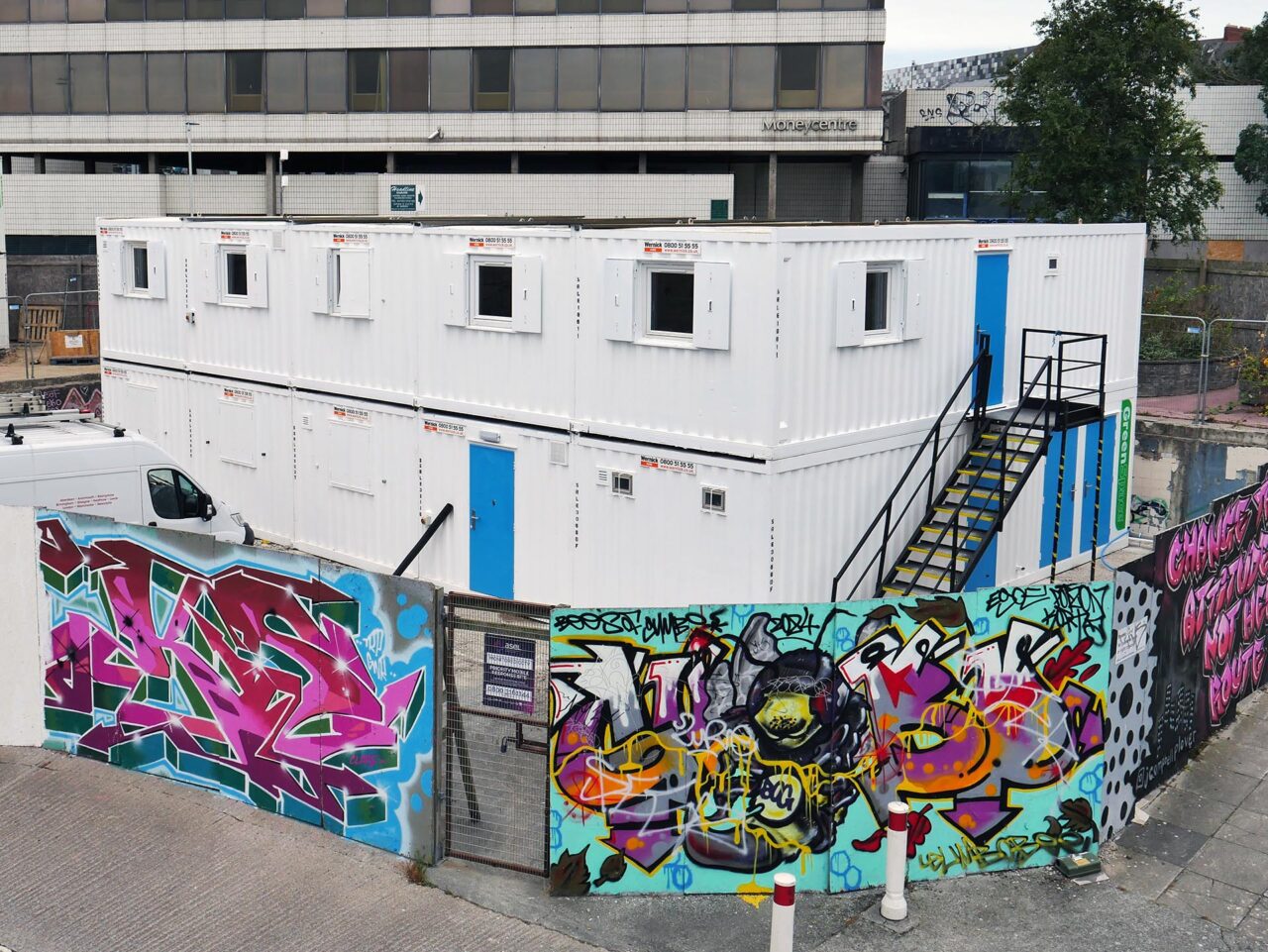
On constrained urban sites, refurbishment projects, school extensions, hospital works and town centre developments, site compounds are often positioned close to the works. In these situations, Section 13.3 requirements are typically considered.

What section 13. 3 means in practice
When a 6m fire break cannot be achieved, the temporary building should be designed and constructed to meet defined fire performance criteria.
This includes:
- Fire-rated wall assemblies
- Fire-rated floor and roof structures
- Fire-rated windows and/or shutter assemblies
- Fire-rated door assemblies
Performance is typically assessed against EN 13501 classifications, with ratings such as REI30 or E30 depending on the element.
In simple terms, the building must be capable of containing fire for a defined period, helping to prevent spread to adjacent structures or the works themselves.

Why this is becoming more relevant
Urban regeneration projects, phased refurbishments and live-environment works often leave little room for generous separation distances. At the same time, project values continue to rise. JCoP 10.2 is commonly applied on higher value projects, typically above £2.5m, although application can vary depending on insurer requirements and project-specific risk assessments.
Insurers, fire risk assessors and principal contractors are paying closer attention to temporary accommodation compliance, particularly on high-value projects.
In addition, JCoP 10.2 introduced updates that apply to buildings, where separation distances are less than 6m, manufactured after 1 January 2025, reinforcing expectations around testing and performance.
In short, fire compliance for temporary buildings is under greater scrutiny than ever.
Designing for constrained sites
FMflex is Wernick Hire’s fire-rated modular system, developed for projects where separation distances are limited. It is suitable for single and multi-storey applications and designed to align with relevant fire performance requirements where applicable.
Key features include:
- Corrugated steel exterior with vinyl-faced fireline plasterboard
- Fire-rated wall and roof assemblies
- Double-glazed uPVC windows
- Secure Kirncroft fire-rated doors as standard
- Compliance with JCoP 10.2 Section 13.3 requirements
The system is designed to provide both fire performance and practical site accommodation, including office, canteen, welfare and meeting room configurations.
Importantly, it is engineered for projects where fire separation is constrained, not adapted after the fact.
Early specification reduces risk
Fire requirements should be considered during compound design to ensure the correct type of accommodation is specified.
This includes:
- Confirming whether a 6m fire break can be achieved
- Understanding whether enhanced fire performance may be required
- Selecting a suitable temporary building system based on project constraints
On constrained sites, these decisions are often driven by layout limitations and project requirements, rather than being something that can be changed later.

The bottom line
If a 6m fire break can be achieved, a wider range of temporary accommodation systems may be suitable.
If it cannot, fire performance requirements are likely to change depending on project-specific factors such as risk assessments and insurer expectations.
Understanding this distinction early helps ensure the correct solution is selected.
As sites become more constrained and project values increase, fire-rated modular solutions for Section 13.3 compliance will play a growing role in insurable project delivery.
If you are planning a compound for a constrained site and are unsure which category applies, it is worth having that conversation early.